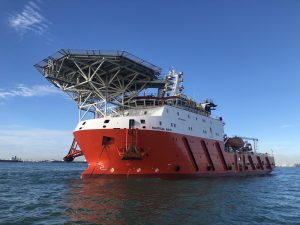
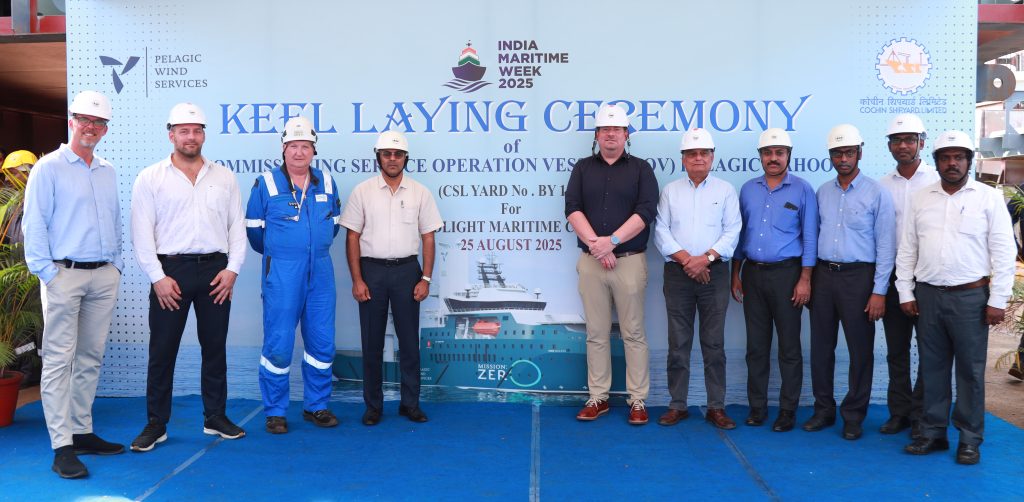
Pelagic Partners and Pelagic Wind Services are proud to announce the successful keel laying of our second Commissioning Service Operation Vessel (CSOV), Pelagic Wahoo, at Cochin Shipyard in India.

The ceremony was attended by senior representatives from Pelagic Wind Services, alongside colleagues from Cochin Shipyard, DNV, and other stakeholders, highlighting the real collaborative effort behind the latest milestone in the project.


The construction of Pelagic Wahoo is based on the proven Kongsberg UT 5520 MH design. This focuses on delivering a vessel with advanced safety aspects, operability, and seakeeping performance as well as improved sustainability with reduced fuel consumption and associated emissions. With hybrid propulsion, permanent magnet azimuth thrusters, and next-generation ship automation, the vessel is equipped to deliver both operational and environmental benefits.
A large battery bank allows port operations to be conducted on battery power alone, while methanol-ready systems future-proof the vessel for low-carbon fuel adoption. At 93 metres long and 19.5 metres wide, with accommodation for 120 personnel including windfarm technicians, this CSOV represents a vital asset for the growing offshore wind sector.
For Pelagic Partners, the second keel laying service reflects our continued investment in advanced, sustainable offshore solutions. The CSOVs developed under our Pelagic Wind Fund will play a pivotal role in supporting the industry’s transition to renewable energy, while offering strong value creation and returns for our investors.
With the delivery of our two CSOVs scheduled for 2026, we are positioning ourselves to play an important role within offshore wind support operations at a time when the shift towards renewable energy solutions continues to grow. The keel laying of the Pelagic Wahoo follows the ceremony held in December 2024 for our first CSOV, Pelagic Walu, highlighting the progress made across our offshore fleet programme.
Together, these vessels highlight our ambition to combine ship design, sustainable technologies, and disciplined investment to meet the evolving needs of the global energy sector.